- The Lifestyle Entrepreneur
- Posts
- The Accountability ChartTM - The Most Powerful Tool in EOS®
The Accountability ChartTM - The Most Powerful Tool in EOS®

Mike Jones
September 12, 2025
Read time - 5 minutes
Most people are familiar with the org chart. And if you've heard of EOS®, you've probably heard of the Accountability Chart™ too.
But here’s what I see with most teams—even those running EOS®: they build it once, then forget about it. And that’s when they miss out on its real power.
Most companies get excited about the clarity it provides but fail to use it the right way, which causes it to sit in a folder collecting dust.
This is a massive missed opportunity, because if used well the Accountability Chart is the most important tool in the EOS® toolkit.
Let me show you how to use it:
What is the Accountability Chart
Why it’s the backbone of your business
What occasions should force you to use it
What Is the Accountability Chart™?
The Accountability Chart is NOT just a glorified org chart.
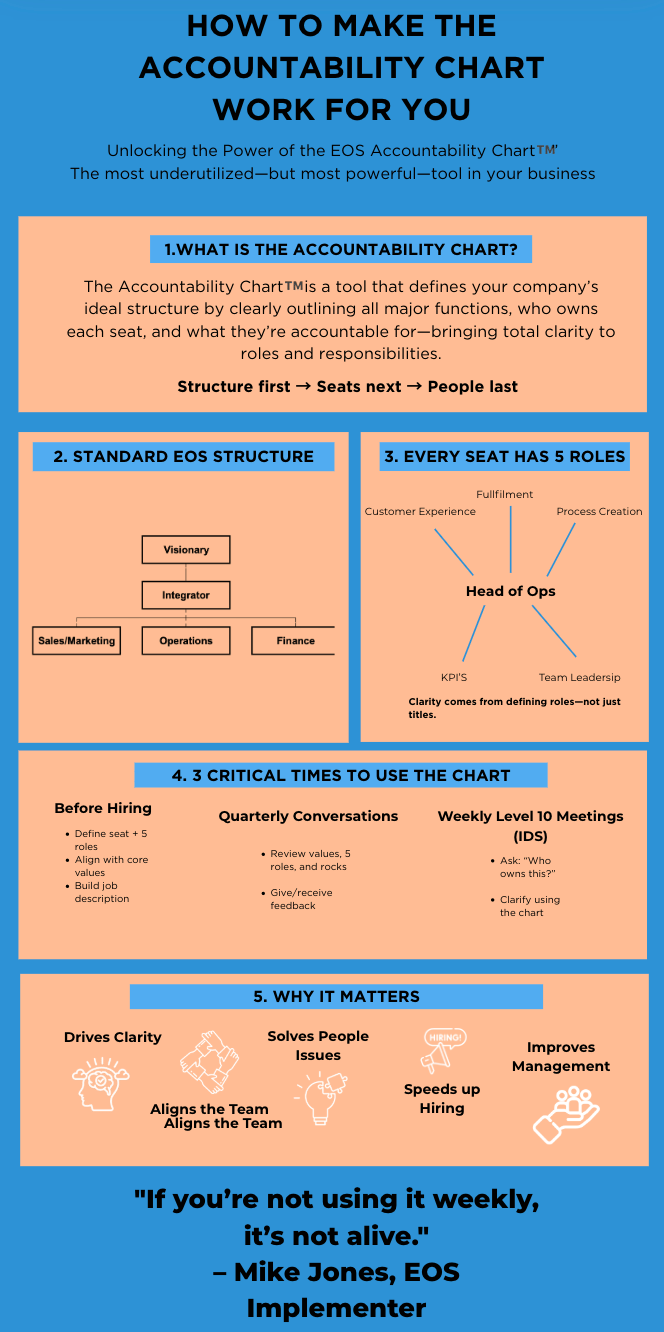
It’s a tool designed to build the right structure for your company, assign complete accountability for everything that happens in your company, and places the right people in those seats.
Here’s how it’s built:
Structure first – Define the right structure for your company
Roles next - What are the 3-5 roles each seat is accountable for?
Then people – Fill the seats with the right people
EOS applies the belief that every company has at least 3 core functions:
Sales/Marketing – Driving growth
Operations – Delivering the product/service
Finance/Admin – Managing the back office
Plus an Integrator—the person who keeps it all moving day to day.
And a Visionary—the big-picture thinker with a million ideas (usually the founder).
Once those top-level roles are clear, you identify 3 to 7 core functions unique to your company, add all the functional seats that cover all work done, and define the five key roles for each seat.
This becomes your organizational backbone. Every person knows where they sit and what they’re responsible for.
Most Teams Get It Wrong
Too often, teams put time into building an Accountability Chart once—and then let it collect dust.
Here’s the problem:
If it’s not actively used and updated, it loses all its power.
But if you use it the right way, it will:
Drive clarity
Reduce confusion
Improve hiring
Increase accountability
Solve people issues fast
Make everyone enjoy their work better
The 3 Times You Must Use the Accountability Chart
Saying “update and use the Accountability Chart often” doesn’t work. Teams need simple triggers to know when to pull out and use it.
While there are many times it helps to use it, here are three critical moments where your Accountability Chart should be front and center:
1. Before You Hire
Most people write a job description first, then try to figure out what the role is. EOS® flips this.
Before you post anything or have any interviews, do this:
Identify the seat on the Accountability Chart you need to fill
List the five roles the person will own
Outline the measurables they’ll be accountable for
Align the role with your core values
Then—and only then—write the job description. You’ll hire better, faster, and clearer. Following this process means you can’t ever hire someone without first updating your Accountability Chart.
2. Quarterly Conversations
In EOS, every person has a quarterly conversation with their manager—a casual, 60–90 minute check-in on:
Core values alignment
Performance in their five roles
Progress on their rocks (90-day goals)
To properly prepare for this meeting - both parties need to review the Accountability Chart to understand their five roles, so it must be updated before each Quarterly Conversation.
3. Weekly IDS Sessions
Every EOS team runs a Level 10 Meeting™ each week. At the heart of it is IDS:
Identify. Discuss. Solve.
When issues come up, one of the best questions you can ask is:
“Who owns this issue?”
If no one knows, it’s time to pull out the Accountability Chart and clarify.
Another great question to ask with identifying an issue is:
“What type of issue is this?”
If it’s a people issue - pull out the Accountability Chart to ensure you’re clear on ownership.
Final Thoughts
The Accountability Chart isn’t just a planning tool.
It’s a living document—a structure that should guide your:
Hiring
Leadership development
Problem solving
Accountability
When used correctly, it becomes the most important tool in EOS. It brings your business structure to life and helps solve countless issues by simply answering the question:
“Who owns what?”
If you're serious about scaling your business and creating accountability at every level, this is where it starts.
Want to see how this applies to your team? Let’s talk.